

How to analyze a video game: a five-layer framework
A rubric for game competitive analysis


Heads up: the game competitive analysis framework is about a third of the article. The rest is two full sample analyses. While I hope they provide clarity, please treat them as supplementary.
Most competitive analysis in game development defaults to vibes. We play a game, we like it or we don’t, we reverse-engineer a handful of reasons why and we move on. If a game we loved failed commercially, we blame marketing or timing without asking whether the creative work itself was misaligned with its market. A game that aligns with our taste gets credit for things it didn’t actually do well. A game that doesn’t gets blamed for problems that aren’t the real issue.
Neither of those helps you make better decisions about your own work.
The framework I’m presenting here is designed to force analytical rigor. It’s structured in five layers that build understanding progressively: context (what world did the game enter), positioning (who was it for and did it find them), business (did the commercial reality match the ambition), creative experience (does the game deliver on its creative promise) and synthesis (what actually happened and what does it mean). Each layer asks specific questions. Together, I believe they can provide a pretty complete picture of why a game succeeded or struggled.
This isn’t academic. It’s practical. If you’re making a game in a crowded genre, you need to understand why similar games succeeded or failed, and “they had good design” or “the marketing was weak” won’t cut it. You need to know what the actual leverage points were. You need to see where decisions got made that determined outcomes. You need a causal chain, not a scorecard.
I’ve used earlier versions of this framework myself. Not every layer carries equal weight for every game. A game that failed primarily because of positioning doesn’t need a deep creative analysis. A game that succeeded despite weak marketing because the creative work was singular deserves most of your attention on the creative layer. The structure is a checklist of what to consider, not a mandate for equal treatment.
I’m going to walk through the framework first, then apply it to two real games: Inside, by Playdead and Ashen, by A44. Inside is worth studying because it’s a critical and commercial success that did almost everything right and understanding how and why is instructive. In contrast, Ashen is worth analyzing because it’s a good game that got a lot right but also had a few more nuanced issues that kept it from being the success it could have potentially have been.
The five-layer framework
Layer 1: context
Before you touch the game itself, establish the environment it was released into. This is where most analyses move too fast.
Market and genre landscape. What did the genre look like at launch? Was the space crowded, nascent or oversaturated? Who were the direct and indirect competitors? What had recently succeeded or failed in adjacent territory and why might players have been primed or fatigued for this kind of game?
Studio and development context. Who made it and what’s their trajectory? Is this a debut, a pivot, a follow-up to a hit? What were the production circumstances: team size, funding, timeline, engine choice, whether it went through early access? For indie games this layer is often the most explanatory one, because constraints shape decisions more directly than intent.
Platform and distribution. Where did it launch and was that the right call? PC-only vs console day-one, Steam vs Epic vs Xbox Game Pass vs console storefronts, early access vs direct release. Each of these is a strategic choice with real consequences on audience shape and review dynamics.
Timing and cultural moment. Was there a tailwind or a headwind? Did it release alongside a major competitor? Did it catch a cultural moment or miss one?
Layer 2: positioning
Target audience. Who did the studio appear to be making this for? Was that audience well-defined, underserved, or already well-served? For indie games especially, it’s worth asking whether the game had a clear intended player, because the failure mode of many indie games is making something for a diffuse, imagined audience.
Value proposition and differentiation. What was the game’s core pitch? What did it promise to do differently, better or more honestly than alternatives? This doesn’t have to be the marketing pitch. It’s the implied promise the game makes in its first hour.
Discoverability and marketing. How did the game reach people? What was the visibility strategy: press coverage, streamer seeding, festival presence, social media, Kickstarter history, word of mouth? For indie games, discoverability is often more decisive than quality. A good analysis quantifies this where possible (Steam reviews, Twitch peak viewership, SteamDB estimate ranges) and explains the gap between potential and reach.
Reception snapshot. Critic vs player reception, Steam review sentiment, community discourse. Were there specific pain points that emerged consistently? A divergence between critic and player scores often signals something worth investigating.
Layer 3: business
Pricing strategy. Was the price calibrated to perceived value and audience? Mispricing (too high relative to scope, or too low and signaling a lack of confidence) is a common indie mistake. Were there launch discounts, bundles or regional pricing, and did those choices help or undercut the game’s perceived value?
Sales and financial outcome. What do available signals tell us: SteamSpy estimates, developer-disclosed numbers, awards, sequel greenlighting, studio survival? The analysis should form a hypothesis about whether the game was a financial success relative to its likely budget and be honest about uncertainty. “We don’t know but here’s what we think the signals suggest” is valid.
Post-launch support. Did the studio patch and update? Was there DLC and was it well-received? Did they engage with community feedback? Post-launch behavior sometimes reveals how confident the studio was in their foundation and how healthy the relationship with the player base became.
Business model fit. For premium games, the central question is whether the price-to-content ratio held up. But it’s worth also asking: was there untapped value in early access, a cosmetic DLC strategy or a sequel hook that was never pulled? For games that underperformed, could a different model have changed the outcome or was the problem upstream of monetization entirely?
Layer 4: creative experience
Fantasy. Before any loop or system can be evaluated, a game needs to answer a more fundamental question: what does it feel like to be in this game? Every great game is built around a fantasy, not necessarily a narrative one, but an experiential one. The promise of what you’ll become or feel while playing. A game that articulates this fantasy clearly, and then builds every mechanic, visual and sound to serve it, creates an experience players remember and evangelize.
Core loop. Once the fantasy is established, the core loop is the mechanical engine that delivers it. This is the series of actions the game intends you to perform, moment to moment and session to session. What you do, what that produces and how that feeds back into what you do next. Is the loop well-designed? Does it give players clear agency at every step? Is the moment-to-moment execution captivating or does it become rote? Does the loop scale (remain interesting as players develop mastery) or does it plateau quickly?
Onboarding and accessibility. First impressions are disproportionately determinative of retention. How steep is the initial curve? Does the game respect the player’s time and assumed competence? Does it teach through play or through instruction? For indie games, which often lack the QA resources to smooth rough edges, a demanding or confusing onboarding can produce a first-week review score that permanently anchors player perception.
Systems design and depth. How do the game’s interlocking systems create complexity and replayability over time? Where does depth come from: mechanics, narrative branching, procedural generation, build variety, emergent interaction between systems? This is where you assess whether the game has legs, not just a good first hour. Shallow systems can sustain a short, focused experience but become a liability the moment the game asks for more time than it can justify.
Pacing and structure. How is the experience shaped over time? Where does it peak, drag or overstay its welcome? Pacing failures are often invisible in the first session and fatal by the third. A game that front-loads its best ideas and coasts on repetition afterward loses its word-of-mouth precisely when it should be building it.
Art direction and audiovisual coherence. For indie games especially, visual and audio identity punch above their weight in marketing and first impressions. The question isn’t “is it pretty” but “is it coherent and intentional?” A distinctive aesthetic executed with conviction (even a lo-fi or minimalist one) can be more commercially valuable than a generic high-fidelity one, because it creates a recognizable identity that travels through screenshots, trailers and thumbnails before a player ever touches the game.
Narrative and tone. If story is part of the game’s value proposition, how does it land? Does the mechanical experience support or undermine the intended tone? Some of the most interesting failures here aren’t in the writing itself but in the dissonance between what the game says it’s about and what it actually makes you do.
Technical state at launch. Bugs, performance, platform parity. Launching in a rough technical state can be fatal to review scores and word-of-mouth in a way that a patch six months later rarely repairs. The question isn’t just “was it buggy” but “did the technical state signal something about the game’s readiness and how did that shape early perception?”
Layer 5: synthesis
This is what separates a teardown from a review or a design postmortem. It’s the hardest part and the most valuable.
The central argument. Every good analysis needs one. Not a list of pros and cons but a thesis: this game succeeded or struggled primarily because of X, which was caused by Y, and was amplified or dampened by Z. You should leave with a clear explanatory story, not a balanced scorecard.
Key leverage points. Where did the decisions that actually determined the outcome get made - in development, in positioning, in pricing, in launch execution? This is where you connect the dots across all five layers. Two or three leverage points is usually enough. The goal is the short list of decisions or circumstances that everything else cascades from, not an exhaustive account of every choice the studio made.
The causal chain. Where did the decisions that determined the outcome actually get made: in development, in positioning, in marketing timing, in launch execution? This is the moment to connect the dots across all five layers. The best analyses find the moment of leverage when there is one: the single decision, circumstance or miscalculation that everything else cascades from.
What to take from this. What can a developer actually do differently because of this analysis? These should be generalizable but concrete. Not "make a good game" but "in a crowded genre, a distinctive visual identity may matter more to discoverability than gameplay depth, because players decide whether to click before they decide whether to play." If a lesson dissolves on contact with a real decision, it's not a lesson - it's a truism. Cut it.
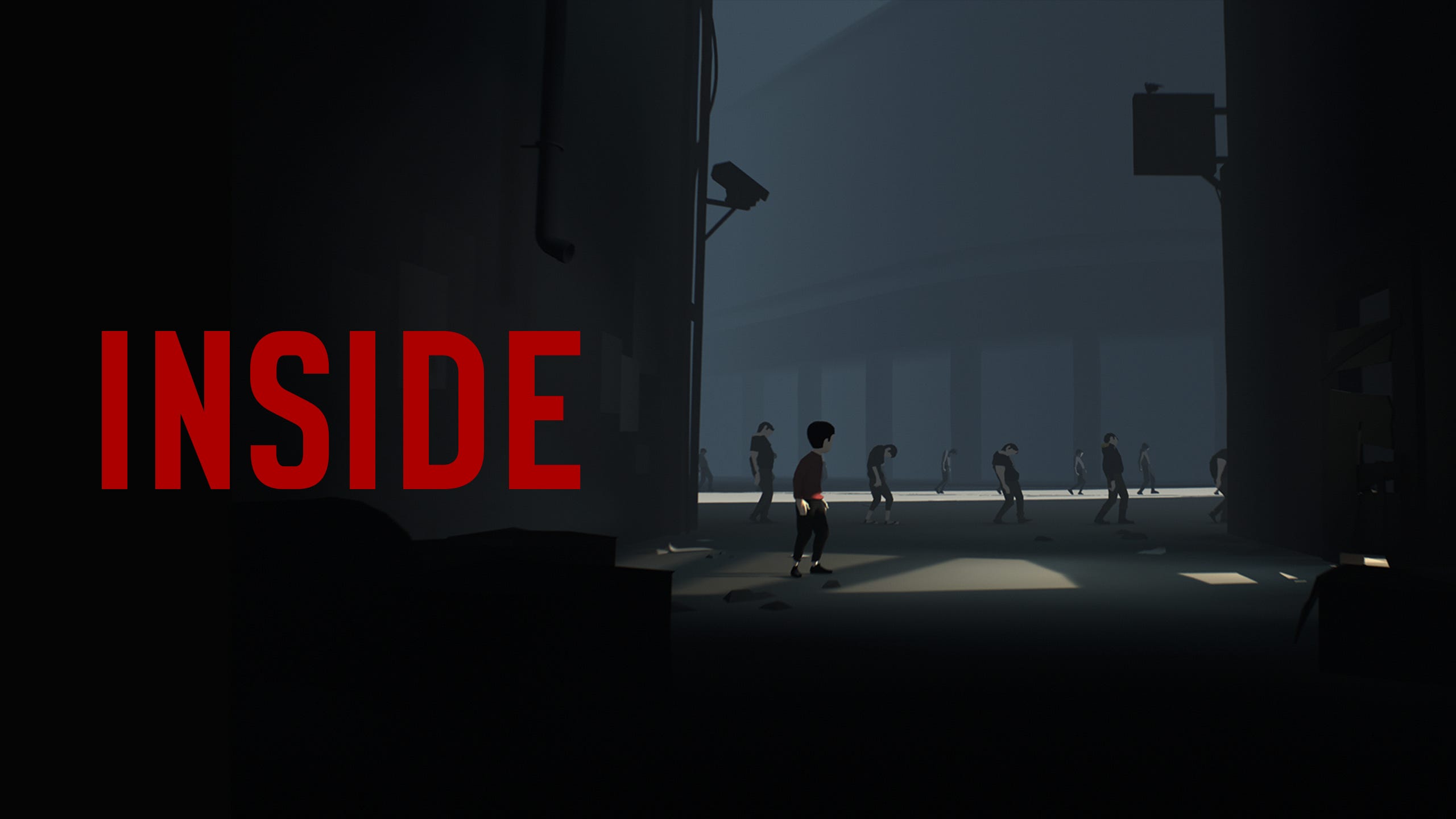
Inside: a five-layer teardown
Layer 1: context
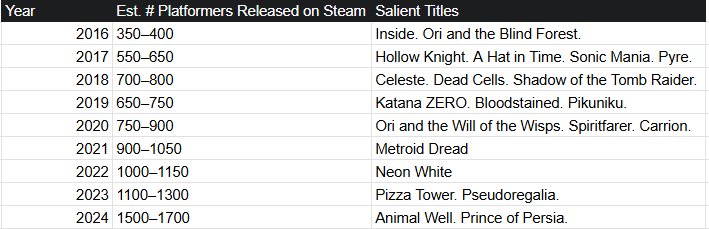
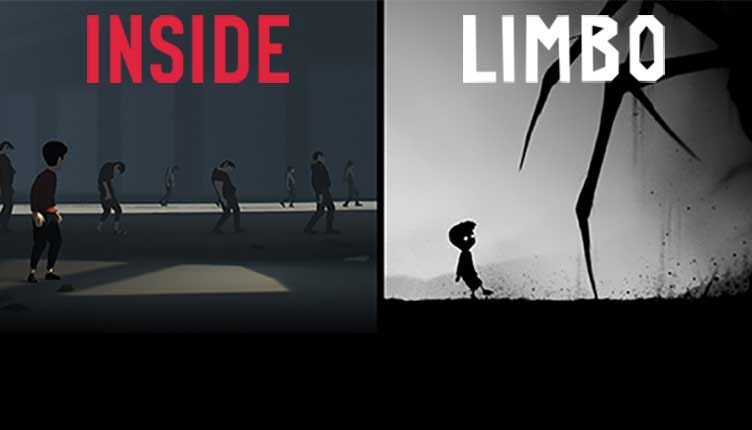
Market and genre landscape (2016). Inside launched into a puzzle-platformer space that was mature but not oversaturated. The indie scene in 2016 was crowded with platformers, but most were either action-focused (Celeste wouldn’t release until 2018) or lighthearted (the tail end of the retro pixel art wave). Atmospheric, narrative-driven platformers were less common. Limbo’s success in 2010 had proven there was an audience for dark, minimalist puzzle-platformers, but six years had passed. The space wasn’t fatigued. If anything, players were primed for Playdead’s return.
Studio and development context. Playdead was a 25-person indie studio in Copenhagen. Inside was their second game, following Limbo’s critical and commercial success (over 1 million copies sold). The studio had institutional knowledge, technical capability and brand equity. Development took six years (2010-2016), an unusually long cycle for an indie game, but Playdead was self-funded after Limbo’s success and received a $1 million grant from the Danish Film Institute. The team switched from a custom engine (used for Limbo) to Unity to simplify development, adding their own temporal anti-aliasing rendering routines (later open-sourced).
This context matters. Inside wasn’t a debut or a pivot. It was a studio leveraging its strengths: experience making atmospheric platformers, technical capability to create a signature visual style and the financial runway to take the time needed. The six-year development cycle signals a commitment to quality over speed.
Platform and distribution. Inside launched on Xbox One first (June 29, 2016), then Windows via Steam (July 7), followed by PlayStation 4 (August 23). The Xbox exclusivity window was likely part of a deal that provided funding or marketing support. Microsoft featured Inside prominently at E3 2014 and 2016. The game later came to iOS (December 2017), Nintendo Switch (June 2018) and macOS (June 2020).
The multi-platform strategy was ultimately correct. Puzzle-platformers have broad appeal across console and PC audiences. The Xbox launch first gave the game Microsoft’s marketing weight and Game Pass visibility, while the quick Steam follow-up captured PC players who had supported Limbo.
Timing and cultural moment. Inside released in the summer of 2016, a relatively quiet period for major releases. No direct competitors launched alongside it. The game benefited from six years of anticipation (Limbo fans had been waiting), Microsoft’s E3 showcase presence and a free Limbo promotion on Xbox in advance of Inside’s release. There was no headwind. If anything, the timing was ideal.
Layer 2: positioning
Target audience. Inside was made for players who value atmosphere, environmental storytelling and puzzle-solving over action. The target audience overlaps with Limbo’s fanbase but extends to anyone drawn to narrative-driven indies with artistic ambition. This was a well-defined, underserved audience in 2016. Most puzzle-platformers were either too light (mobile-casual) or too action-heavy (Ori and the Blind Forest). Inside occupied a distinct niche: dark, minimalist, thoughtful.
Value proposition and differentiation. Inside’s core pitch: a hauntingly atmospheric puzzle-platformer with environmental narrative, stunning visuals and thematic depth rarely seen in games. The differentiation was clear: it wasn’t just Limbo 2, it was an evolution. More color (muted but present), more complex puzzles, more ambitious scale (the Huddle sequence) and more thematic ambition (conformity, surveillance, loss of agency). The game promised to make you feel something uncomfortable and stay with you after it ended.
Discoverability and marketing. Inside had exceptional visibility for an indie game, largely because of Playdead’s track record and Microsoft’s support. Key discovery drivers:
Microsoft E3 showcases (2014, 2016): massive exposure to core gaming audience
Critical acclaim from previews: IGN, Polygon, Kotaku and others covered it extensively pre-launch
Limbo’s legacy: players who loved Limbo were actively looking for Inside
Game Pass inclusion: Inside was an early Game Pass title, giving it additional reach
Strong press relationships: Playdead had earned trust with press through Limbo
Steam reviews: 65,154 reviews at 96% positive. SteamSpy estimates 2-5 million owners on Steam alone. This is exceptional discoverability for an indie game, though much of it came from quality and word-of-mouth rather than paid marketing.
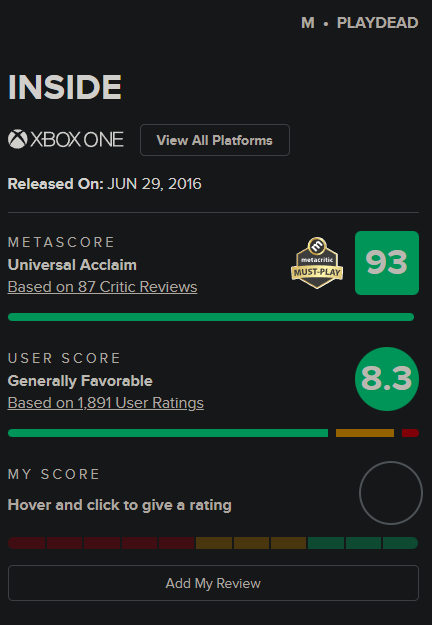
Reception snapshot. Inside received near-universal critical acclaim. Metacritic: 87 (PC), 91 (Xbox One), 93 (PS4). User scores on Steam: Overwhelmingly Positive (96%). Critics praised the art direction, sound design, atmosphere, pacing and thematic depth. Some criticized the ambiguous ending, but most saw it as a strength.
There was no divergence between critics and players. Both groups loved it. The few criticisms that emerged were about the short length (3-4 hours) relative to the $20 price, but this was a minority view and didn’t impact the overall reception.
Layer 3: business
Pricing strategy. Inside launched at $19.99 on all platforms. This was well-calibrated. The price signaled premium indie quality without overreaching. $20 for a 3-4 hour game is defensible when the experience is polished, memorable and replayable (achievement hunters, secret ending). The price also positioned Inside as a deliberate, focused experience rather than a sprawling one. No launch discount, no bundles initially. The game earned its price.
Sales and financial outcome. Steam revenue calculator estimates $76.8 million in gross revenue from Steam alone (this includes all platforms via Steam keys and direct sales). Net developer revenue after platform cuts, refunds, discounts, and VAT: approximately $22.7 million. SteamSpy estimates 2-5 million owners on Steam. Console sales (Xbox, PlayStation, Switch) likely pushed total units to 4-6 million across all platforms.
Development budget is not publicly disclosed but we can estimate. 25-person team for 6 years in Copenhagen (high cost of living). Rough estimate: $15-20 million total development cost. At $22.7 million net revenue from Steam alone, Inside was highly profitable before counting console sales, mobile sales and ongoing revenue from continued sales and bundles.
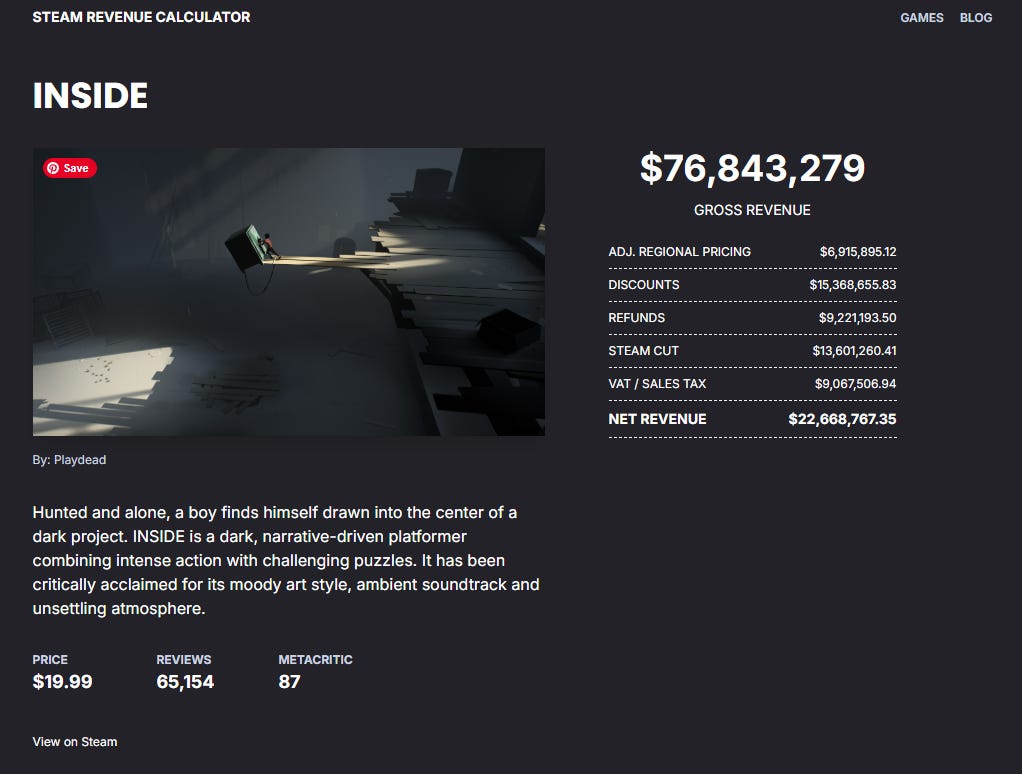
This is a clear financial success. Playdead could afford to take six years because Limbo had funded the studio, but Inside more than paid for itself and set the studio up for their next project and then some.
Post-launch support. Playdead patched bugs and performance issues shortly after launch but did not release DLC or major content updates. This was the correct decision. Inside is a tightly crafted, complete experience. Adding DLC would have diluted it. The studio focused instead on porting to additional platforms (iOS, Switch, macOS), which extended the game’s reach and revenue.
Business model fit. The premium model was perfect for Inside. A $20 upfront purchase for a complete, focused experience. No microtransactions, no early access, no episodic structure, no shenanigans. The game’s value proposition (a singular artistic experience) wouldn’t have worked with free-to-play or games-as-a-service. The model aligned with the product.
Layer 4: creative experience
Fantasy. Inside’s fantasy is not power or mastery. It’s vulnerability and compulsion. You are a small boy in a hostile world, hunted and alone, drawn inexorably toward something you don’t understand. The fantasy is atmospheric dread, the feeling of being watched, the discomfort of moving forward because you have no other choice. Every visual, sound and mechanic reinforces this. The boy’s animations are fragile. The environments are oppressive. The sound design is sparse and unsettling. The game never lets you feel safe.
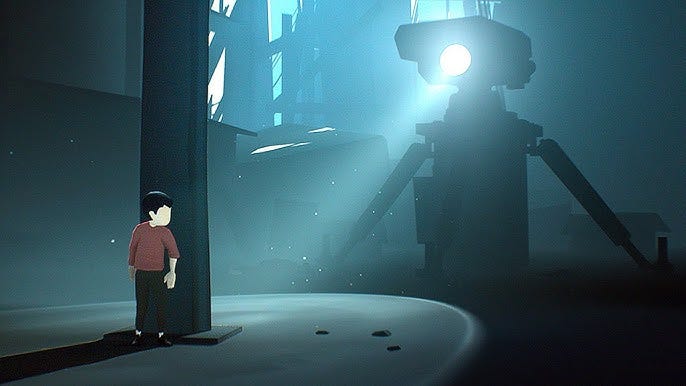
This is a coherent fantasy executed to perfection. Inside doesn’t waver. It doesn’t give you moments of heroism or relief. It commits to its tone from the first frame to the last.
Core loop. The loop is simple: move right, solve environmental puzzles, avoid death, progress. The puzzles involve physics (pushing objects, timing jumps), environmental interaction (activating switches, using mind-control helmets to manipulate mindless workers) and occasional chase sequences. The loop is not about complexity or mechanical depth. It’s about pacing and tension. Each puzzle is just difficult enough to make you think but not so hard that it breaks flow. The chase sequences inject urgency. The loop serves the fantasy: you are always moving forward, always under pressure, never in control.
Onboarding and accessibility. Inside has no tutorial, no text, no UI. You start running and the game teaches you through play. Jump over a log. Climb a ledge. Hide from a searchlight. The learning curve is gentle but immediate. Within five minutes you understand the rules. This is exceptional onboarding design: respectful of the player’s intelligence, confident in its communication and seamless with the experience.
Systems design and depth. Inside is not a systems-driven game. There is no progression, no skill tree, no inventory, no build variety. The depth comes from puzzle design and environmental storytelling. Each puzzle is handcrafted. The game doesn’t rely on procedural generation or emergent interaction. This is intentional. Inside is a linear, authored experience and that’s its strength. The lack of systems allows the game to maintain perfect pacing.
Pacing and structure. Inside’s pacing is relentless. The game opens with a chase sequence that establishes the tone immediately. From there, it alternates between quiet exploration, environmental puzzles and high-tension chase sequences. The pacing never drags. Each environment introduces new visual ideas and puzzle mechanics. The game builds toward the Huddle sequence, a shocking tonal and mechanical shift that serves as both climax and commentary. The secret ending (accessed by finding hidden orbs) provides an alternate conclusion that recontextualizes the entire experience.
Inside is 3-4 hours long and that length is perfect. The game doesn’t overstay its welcome. Every moment is intentional. This is pacing discipline most games lack.
Art direction and audiovisual coherence. Inside’s visual identity is its most immediate strength. The game uses a muted color palette (grays, blues, reds) and a 2.5D perspective with depth-of-field effects that create a cinematic look. The lighting is dramatic and deliberate. The boy is rendered in silhouette or partial silhouette for much of the game, emphasizing vulnerability and anonymity. The environments are industrial, decayed, and oppressive: factories, farms, laboratories, underwater facilities.
The sound design (by Martin Stig Andersen, who also worked on Limbo) is sparse and atmospheric. There is no music in the traditional sense. Instead, ambient sound and environmental audio create tension. Footsteps, water, machinery, breathing. The soundscape is as important as the visuals in creating the game’s atmosphere.
This coherence is what makes Inside so memorable. Every visual and audio choice serves the tone. Nothing is extraneous. The game has a signature look that travels through screenshots and trailers, making it instantly recognizable.
Narrative and tone. Inside has no dialogue, no text, no explicit exposition. The narrative is environmental. You piece together what’s happening through visual cues: the mind-control helmets, the farms where mindless workers are grown, the laboratories where experiments are conducted, the Huddle (an amalgamation of bodies that becomes a grotesque escape mechanism or perhaps the culmination of the experiment you’ve been part of all along).
The themes are conformity, surveillance, control, loss of agency and the commodification of human beings. The game never explains itself. The ambiguity is deliberate. Players are left to interpret. Some see the boy as an escapee. Others see him as a failed experiment. Still others see the entire game as a metaphor for the player’s relationship to the game itself (you, the player, control the boy; the boy is just another mindless worker).
The tone is bleak, unsettling and uncompromising. Inside doesn’t offer catharsis or resolution. It offers discomfort and questions. This works because the mechanical experience supports it. You are always being hunted, always moving forward without understanding why, always complicit in whatever this world is.
Technical state at launch. Inside launched in excellent technical condition. No major bugs, smooth performance across platforms, tight controls. The game’s technical polish was frequently praised in reviews. This matters. A game with Inside’s tone and pacing can’t afford technical issues that break immersion. Playdead’s six-year development cycle gave them time to refine everything.
Layer 5: synthesis
The central argument. Inside succeeded because Playdead executed a cohesive artistic vision at the highest level while leveraging institutional knowledge, technical capability and brand equity built over six years. The critical and commercial success wasn’t accidental. It was the result of decisions made throughout development: taking the time needed to achieve polish, committing to a singular tone without compromise and positioning the game to reach both existing fans and new players through earned partnerships.
Key leverage points.
Limbo’s success gave Playdead the financial runway and brand equity to take six years on Inside. Without it, they likely couldn’t have afforded the development time. With it, they could prioritize quality over speed.
The decision to commit fully to a dark, atmospheric, narrative-driven experience meant the game had a clear identity and a defined audience. In a crowded indie space, that clarity was essential.
The visual and audio design created a signature aesthetic that was instantly recognizable and highly shareable - driving organic discoverability through screenshots, trailers and word-of-mouth before paid marketing entered the picture.
The game’s pacing, polish and thematic depth meant that players who started it finished it and recommended it. A 96% positive Steam review score is not just about quality. It’s about delivering on the promise the game makes in its first hour.
What to take from this. Brand equity compounds - a strong first game gives you the runway and audience trust to take risks on a second. Time and budget buy polish, but only if you use them with discipline. Atmospheric games live or die on coherence: if Inside had inconsistent tone, weak audio or rough pacing, none of the visual identity would have saved it. And short, focused experiences can justify premium pricing if the quality is there. Length is not value. Memorability is.
Ashen: a five-layer teardown
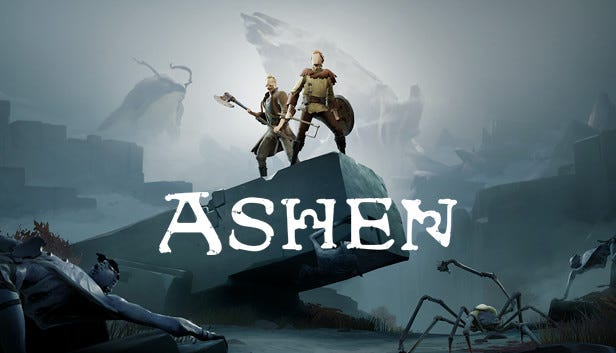
Ashen had the ingredients for a breakout indie success. A distinctive art style, Annapurna’s publishing muscle, Souls-like design from a studio making their debut, Journey-inspired co-op, Microsoft E3 showcases and a four-year development cycle that suggested polish and ambition. The game launched to positive critical reception (Metacritic 78) and was featured prominently alongside AAA titles. It should have been a triumph.
Instead, it was... good. Genuinely good in places. And then a bit frustrating in ways that kept adding up. A game that launched with momentum, received tepid player reception (Steam 67% positive, “Mixed”), sold modestly (20,000-50,000 copies on Steam alone based on SteamSpy, roughly $1.3M net revenue estimate) and unfortunately faded quickly.
The disconnect between what Ashen could have been and what it actually achieved is instructive. This is a teardown about execution gaps, misaligned ambitions and the difference between a good pitch and a game that delivers on that pitch.
Layer 1: context
Market and genre landscape (2018). Ashen launched into a Souls-like space that was mature and increasingly crowded. Dark Souls III had released in 2016. Nioh (2017) had proven the formula could be adapted successfully. Hollow Knight (2017) and Dead Cells (2018) were dominating the indie action space. Salt and Sanctuary (2016) had already proven a 2D Souls-like could succeed. The bar for Souls-likes was high and rising.
The space wasn’t oversaturated yet but players had expectations. They knew what good Souls-like combat felt like, what tight level design looked like, what meaningful progression systems enabled. Ashen was competing not just against other indies, but against the benchmark that From Software had set and refined over a decade.
Studio and development context. A44 Games (originally Aurora44) was a New Zealand indie studio making their first game. The team started with three people and grew to approximately 40 by launch. Development took roughly four years (2014-2018). The studio received support from Annapurna Interactive as publisher and had deals with Epic Games Store (timed exclusive) and Microsoft (Xbox/Windows Store, Game Pass).
This context matters. Ashen was a debut from a studio that had no prior shipped titles, no known institutional knowledge of how to make a Souls-like and no technical foundation to build on. They were learning as they went, using Unreal Engine 4, and scaling a team from three to forty during active development. Compare this to Inside, where Playdead leveraged institutional knowledge and brand equity from Limbo. A44 had neither.
The Epic exclusivity decision was particularly damaging. The game was listed on Steam for years before launch, building a wishlist community, then pulled at the last moment for a timed exclusive on Epic Games Store. This generated significant community backlash and cost the game launch momentum on its intended primary platform.
Platform and distribution. Ashen launched December 7, 2018 on Xbox One (via Game Pass), Windows (Epic Games Store exclusive initially) and later on Steam (December 9, 2019, a full year after launch). It later came to PlayStation 4, Nintendo Switch and iOS.
The Epic exclusivity was possibly a strategic misstep. The PC audience for Souls-likes is primarily on Steam. Launching on Epic meant smaller player base, weaker community tools and angry fans who had been waiting years. When the game finally arrived on Steam a year later, momentum was gone. Reviews on Steam reflected this: players noted bugs that had already been patched on other platforms and the game felt “old” at launch.
Timing and cultural moment. December 2018 was a crowded release window. Super Smash Bros Ultimate launched December 7 (same day as Ashen). Just Cause 4, Soulcalibur VI, Battlefield V and Red Dead Redemption 2 were all fresh releases competing for attention. Ashen had Microsoft’s E3 presence and Game Pass visibility, but it was a small indie competing in a AAA-heavy season.
There was no cultural tailwind. The game released into noise.
Layer 2: positioning
Target audience. Ashen was positioned for players who wanted a “lighter” Souls-like experience with Journey-inspired co-op and distinctive art. The pitch: a more accessible Dark Souls with emotional multiplayer moments and a striking visual style. The target was Souls-like fans who found From Software games perhaps too punishing and Journey fans who wanted more mechanical depth.
This is a reasonable audience, but it’s also a narrow one, and Ashen needed to execute perfectly to satisfy both groups. Souls-like fans want tight combat above all. Journey fans want atmosphere and emotional resonance. Ashen tried to serve both and arguably ended up fully satisfying neither.
Value proposition and differentiation. Ashen’s core pitch: Dark Souls combat + Journey’s passive multiplayer + minimalist art direction + town-building hub. The differentiation was clear in screenshots and trailers. The faceless character design, muted color palette (grays, blues, warm oranges) and low-poly aesthetic created a recognizable identity.
The problem was that the pitch promised more cohesion than the game delivered. The combat felt like a worse version of Dark Souls. The multiplayer rarely worked as intended. The town-building was shallow. The art direction was striking but couldn’t carry the experience when the mechanics didn’t hold up.
Discoverability and marketing. Ashen had strong visibility for an indie:
Microsoft E3 showcases (2015, 2016, 2017): major platform exposure
Annapurna Interactive as publisher: strong indie brand with press relationships
Game Pass inclusion at launch: millions of potential players on day one
Epic Games Store featuring: additional PC visibility (though controversial)
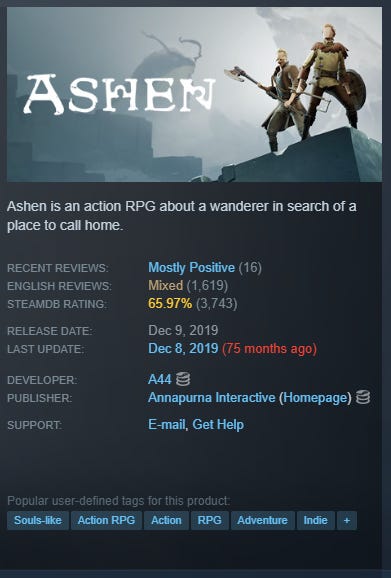
Despite this, player numbers remained modest. SteamSpy estimates 20,000-50,000 owners on Steam. Steam reviews: 3,743 total (as of early 2026), 66% positive. For comparison, Hollow Knight has 172,000+ Steam reviews. Ashen had the visibility but couldn’t convert it to sustained engagement.
Reception snapshot. Critics: Metacritic 78 (PC), generally favorable. Praised for art direction, atmosphere, co-op concept. Criticized for shallow combat, repetitive world design, technical issues.
Players: Steam 66% positive (Mixed rating), significantly lower than critic scores. Common complaints: floaty combat, poor AI companions, empty multiplayer, repetitive enemy design, inventory frustrations, uneven difficulty spikes.
The divergence between critic and player reception is not small. Critics reviewed the game over a few days and appreciated the aesthetic and concept. Players who spent 10-20 hours discovered that the systems were shallow and the execution was at times inconsistent. This gap signals a game that makes a strong first impression but doesn’t sustain it.
Layer 3: business
Pricing strategy. Ashen launched at $39.99 on all platforms. This was perhaps a miscalibration. The price signaled AA-quality scope and polish, but the game delivered a 10-15 hour experience with shallow systems. For $40, players expected more depth, more content or more polish. Souls-like fans could buy Dark Souls III or Nioh for less. The price created an expectation the game couldn’t meet.
A $24.99 launch price would have been better aligned with the actual content and polish level. The $40 price point invited direct comparison to more polished competitors and contributed to the “wait for sale” sentiment in community discussions.
Sales and financial outcome. Steam revenue estimates: $4.3M gross, $1.27M net (after platform cuts, refunds, VAT). SteamSpy: 20,000-50,000 owners. This is Steam only, one year after initial launch. Add Epic, Xbox, Game Pass, and later platforms and total units sold are maybe 100,000-200,000 across all platforms and services.
Development budget is not disclosed, but we can estimate. 40-person team for 4 years in New Zealand. Rough estimate: $8-12 million total development cost (New Zealand salaries are lower than US but still significant). At $1.27M net from Steam plus additional revenue from other platforms and Game Pass payout, the game likely broke even or achieved modest profitability, but nowhere near the success a game with this much visibility should have achieved.
For context, A44 survived and went on to make Flintlock: The Siege of Dawn, which suggests Ashen generated enough revenue (or the studio secured enough funding) to continue. But this was not a breakout success.
Post-launch support. A44 patched bugs and released one DLC (Nightstorm Isle, September 2019). The DLC added a new area and boss fights but didn’t address the core combat and progression issues. Post-launch support was adequate but didn’t fundamentally improve the game. The studio moved on to their next project rather than iterating deeply on Ashen.
Business model fit. The premium model was correct for the type of game Ashen was trying to be, but the price was too high relative to content and polish. Game Pass inclusion helped extend reach, but it also meant many players experienced the game “for free” and had lower tolerance for its flaws. If you paid $40, you might push through frustrations. If you’re browsing Game Pass, you quit and try something else.
Layer 4: creative experience
Fantasy. Ashen’s fantasy is exploration and survival in a harsh, sunless world where you build a home and form fragile connections with other wanderers. You are vulnerable, alone and the world is hostile. But unlike Inside, which commits fully to dread and vulnerability, Ashen hedges a little. It wants to be Dark Souls (mastery through challenge) and Journey (connection and atmosphere) simultaneously. The result is a somewhat muddled fantasy that never fully commits to either.
The tone is somber and melancholic, but it’s not oppressive. The art direction is beautiful, but it’s not cohesive with the punishing mechanics. The multiplayer is meant to create Journey-like moments, but it doesn’t quite work as expected. The fantasy Ashen promises (lonely wanderer finding connection) is somewhat undermined by the mechanical reality (frustrating combat, glitchy co-op, shallow progression).
Core loop. The loop is: explore the world, fight enemies with stamina-based combat, gather resources, return to town to upgrade gear and recruit NPCs, venture further. This is standard Souls-like structure. The problems:
Combat feels floaty and imprecise. Hit recognition is inconsistent. Weapons within the same class have identical movesets, making combat repetitive. Enemy design is limited and recycled. I mean, “underbaked” is the word that keeps showing up in reviews and I don’t think it’s far off.
Progression is shallow. Weapon upgrades aren’t as rewarding as they could be. Character builds lack meaningful differentiation. There’s no stat leveling, only equipment-based progression, which limits player agency and experimentation.
The loop can become tedious quickly. Without meaningful progression or combat depth, the loop becomes just grinding through repetitive encounters to reach the next area, which looks similar to the last.
Onboarding and accessibility. Ashen doesn’t hold the player’s hand, which is appropriate for a Souls-like. But it also doesn’t teach core mechanics as clearly as it could. Players report confusion about stamina management, weapon upgrading and companion AI behavior. The game assumes familiarity with Souls-like conventions but doesn’t execute those conventions well enough to reward that assumption.
Systems design and depth. Ashen’s systems are a bit thin:
Combat: shallow. Limited attack variety, identical movesets within weapon classes, inconsistent hit detection.
Progression: limited. Equipment-based only, no stat customization, upgrades feel unrewarding.
Town-building: cosmetic. NPCs add vendors and minor bonuses but don’t fundamentally change gameplay.
Co-op: multiple issues. AI companions are buggy (falling off cliffs, ignoring combat, failing to revive). Actual multiplayer matchmaking is unreliable. When it works, it’s fine, but it doesn’t work as often as it should.
The game lacks depth to sustain a 15-hour playthrough. Hollow Knight, for comparison, has intricate progression, diverse combat encounters and exploration that rewards curiosity. Ashen doesn’t quite get there.
Pacing and structure. Ashen starts strong. The opening hours are atmospheric, the world feels mysterious, the first boss is satisfying. Then the cracks appear. Difficulty spikes inconsistently, the Seat of the Matriarch dungeon is a notorious wall where many players quit, enemy variety stagnates, the world becomes a bit monotonous and by hour 10 you may be ready to churn.
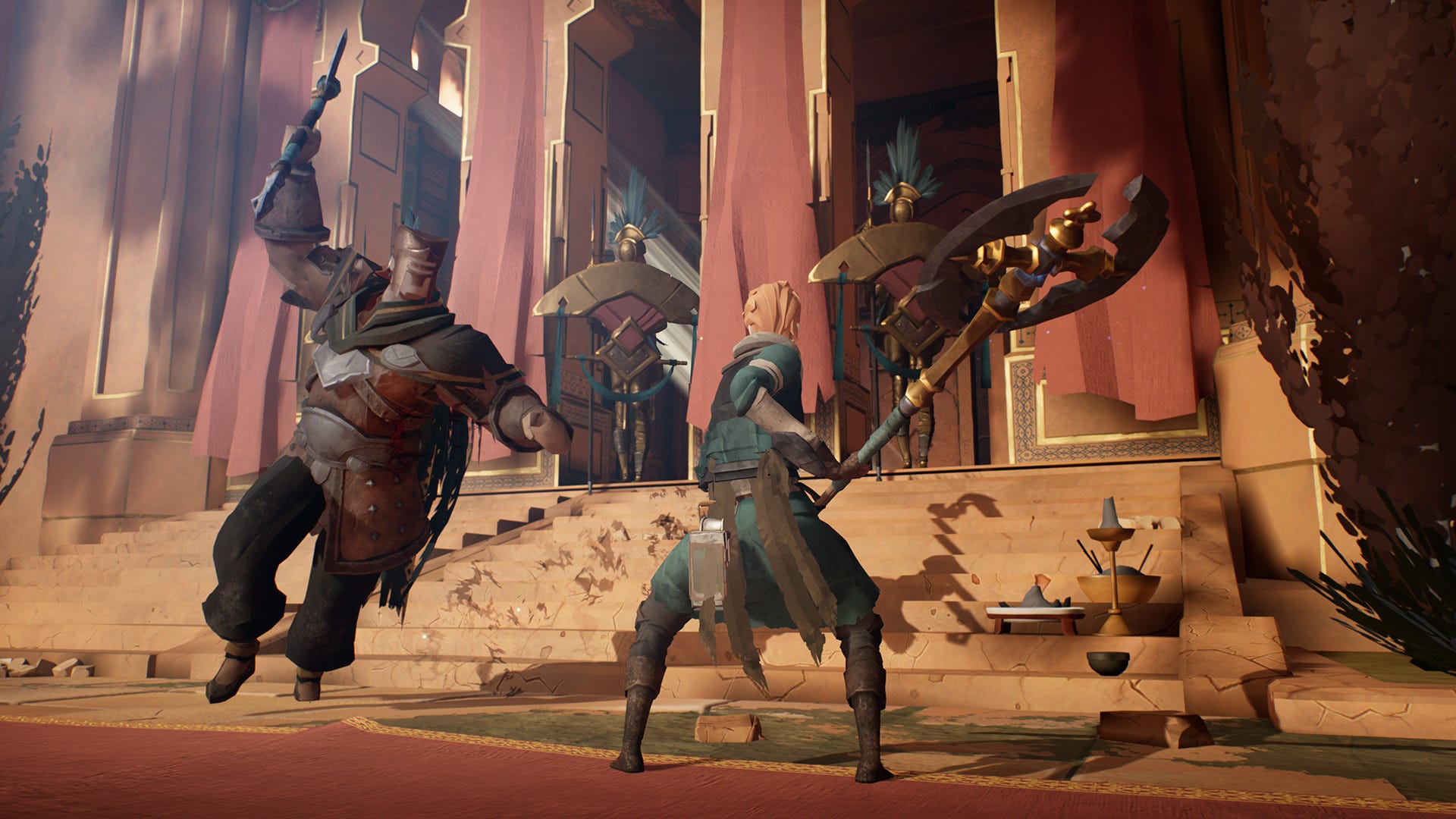
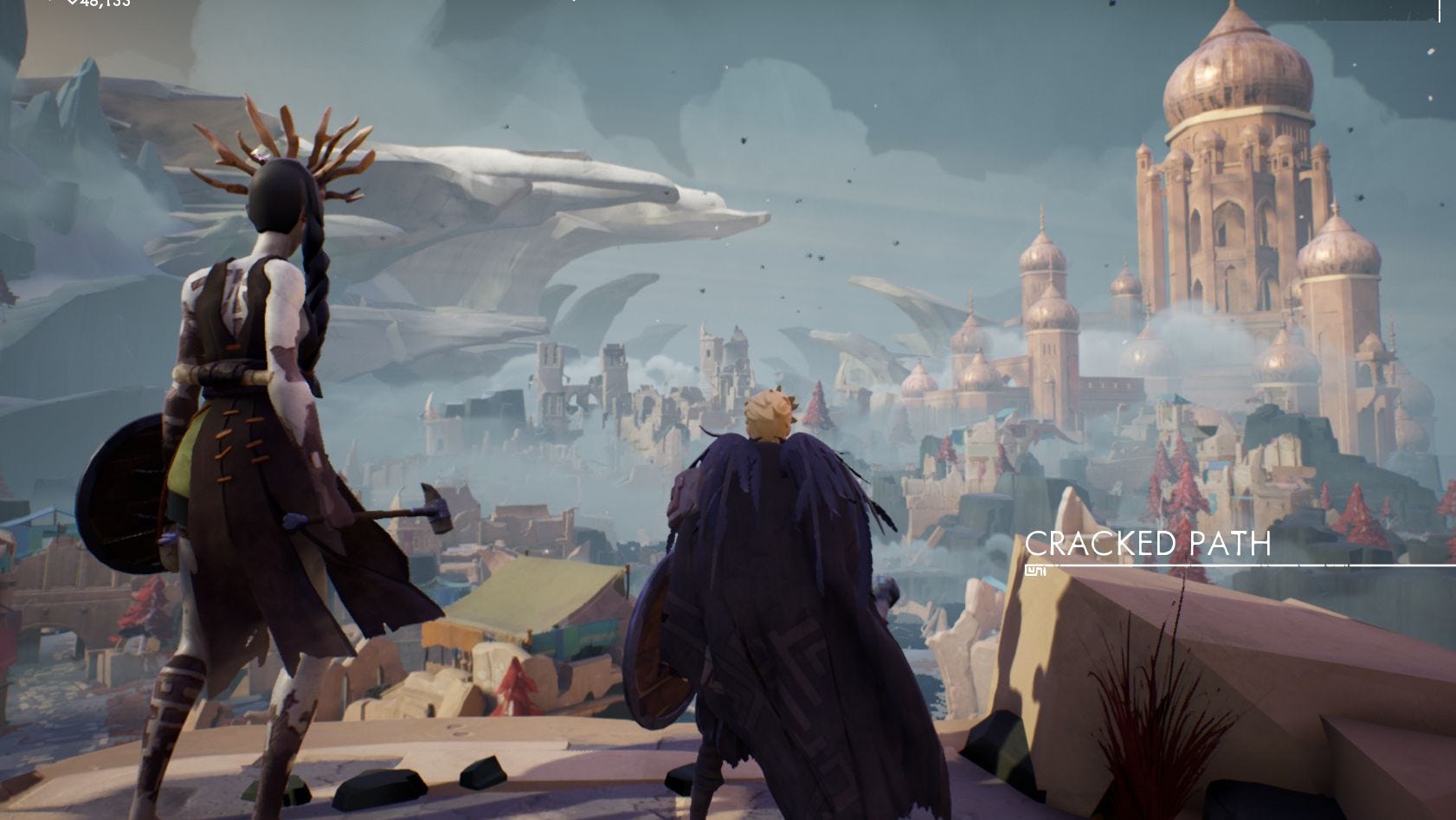
Art direction and audiovisual coherence. This is Ashen’s greatest strength. The faceless character models, low-poly environments, muted color palette (blues, grays, warm oranges at the hub town) and lighting create a distinctive aesthetic. The game is beautiful in screenshots and trailers. The atmosphere is genuinely striking in the early hours.
But art direction alone can’t carry a game when the mechanics aren’t as strong. Players get tired of looking at gray cliffs and brown caves after 10 hours, especially when exploration doesn’t yield meaningful rewards. The audio design is solid, but not enough so to carry the entire game.
Narrative and tone. Ashen’s narrative is environmental and minimal, told through world design and NPC interactions. The story is about rebuilding civilization in a sunless world after the return of light. Thematically, it’s about connection, home and survival.
The problem is that the narrative doesn’t integrate with the mechanical experience. You’re building a town, but it feels like a menu screen, not a living place. You’re forming connections with NPCs, but they’re just vendors with shallow dialogue. The tone is melancholic, but the game never earns that emotion. It tells you the world is harsh and lonely but it doesn’t make you feel it the way Inside does.
Technical state at launch. Ashen launched with bugs and performance issues, AI pathfinding had serious issues - companions falling off cliffs, getting stuck, failing to engage - multiplayer matchmaking was unreliable, frame rate dropped on console and inventory management was genuinely clunky. For a game with four years of development and Annapurna's publishing support, this wasn't good enough.
Layer 5: synthesis
The central argument. Ashen underperformed because it failed to execute the fundamentals of the genre it was imitating. The game had strong marketing positioning, distinctive art direction and conceptual ambition - and none of that was enough once players spent 10-15 hours with shallow combat, unreliable co-op and a world that became repetitive. These execution failures were likely compounded by strategic decisions that added friction: Epic exclusivity that alienated the Steam community, $40 pricing that invited unfavorable comparison to better Souls-likes and a December launch window dominated by AAA competition.
This is a case study in the difference between a good pitch and a game that delivers on it. The pitch worked. The execution didn’t quite.
Key leverage points.
A44 was a first-time studio with no institutional knowledge of Souls-like design, learning to make this type of game while simultaneously scaling a team from three to forty people. That combination is extremely difficult and it shows in the final product.
The decision to build a Souls-like without mastering combat fundamentals was the central failure. If your genre is defined by tight, skill-based combat and your combat feels floaty and imprecise, everything else becomes window dressing on a shaky foundation.
The $40 price point set expectations the game couldn’t meet. At $25, player tolerance for shallow systems would have been higher. At $40, direct comparison to Dark Souls III and Nioh was inevitable and unfavorable.
The co-op system was marketed as the game’s primary differentiator and shipped broken. When your unique selling point doesn’t work, players don’t just feel disappointed - they feel misled.
The Epic exclusivity deal likely made short-term financial sense for a first-time studio. It cost them launch momentum on Steam and generated lasting resentment that colored reviews and word-of-mouth a year later when the game finally arrived there.
What to take from this. You cannot overcome subpar execution in a genre defined by mechanical depth - art direction gets you coverage, it doesn’t carry a game. First-time studios attempting complex genres face compound challenges: if you don’t have institutional knowledge, either start smaller or bring in significant expertise. Price creates expectations, and knowing where your game sits in the quality hierarchy before you set a number is not optional. And ambitious scope without execution depth risks producing hollow experiences - it’s possible Ashen tried to do too much, and each system suffered for it.
In closing
The framework prevents you from attributing success or failure to the wrong causes. Inside didn’t succeed because “it was good.” Ashen didn’t fall short because “it was bad.” Both had strong art direction, major publisher support and E3 showcases. The difference is that Inside delivered on its promise at every layer and Ashen didn’t quite - and the framework tells you specifically where, and why, and what the leverage points were.
That’s what vibes-based analysis can’t give you. Actionable conclusions. The kind you can actually use when making decisions about your own game.
A good concept gets you in the room. After that, you have to deliver.
If this was useful, you might also like:

