

The game developer's career Ikigai
How to be deliberate about your career path in game development

You get good at something while you’re in school. You ship a student project, land a job at a game studio that happened to be hiring when you graduated, in whatever city, for whatever role they had open. And then you spend the next few years getting better at what you were already doing. Each of those early decisions carries more weight than it feels like it does in the moment. The studio type you join shapes what you learn. The genre you work in shapes what you get hired to do next. The skills you develop, or don’t, open some doors and close others, sometimes years before you realize it.
Game development makes this more complicated than other industries industries, because the field is genuinely fragmented: mobile, console, PC and VR are not just different platforms, they’re different industries with different cultures, different pipelines and different expectations of the people who work in them. Indie, AA and AAA are not rungs on a ladder, they’re legitimately different environments that develop people differently. Action RPGs, management sims, narrative adventures and live service shooters require very different skills, and moving between them is harder than it looks from the outside. A career built at a mid-tier studio making free-to-play mobile games is not the same career as one built at an indie team of eight making narrative adventures, even if the job titles match.
That’s a lot to process. It’s a lot of interlocking and synergistic variables influencing your career in ways that are hard to wrap your head around. So it’s not easy to be intentional when making micro-decisions that can have decades-worth of repercussions for your career.
Hence this article. I personally haven’t seen a comprehensive map that helps developers hold all of these variables in front of them at once and ask: does this help me build the career I want? Is this taking me somewhere deliberately, or am I letting the industry decide for me?
So what I’m going to propose here is an adaptation of an old Japanese concept that I think aligns well with making a concerted effort to find fulfillment.
The Ikigai adaptation
Ikigai is a Japanese concept usually translated as “a reason for being.” The model most people have encountered, which is actually a Western adaptation of the original concept, is represented as four overlapping circles: what you love, what you’re good at, what you can be paid for, and what the world needs. The center, where all four overlap, is ikigai. A life with purpose, sustainability and meaning.
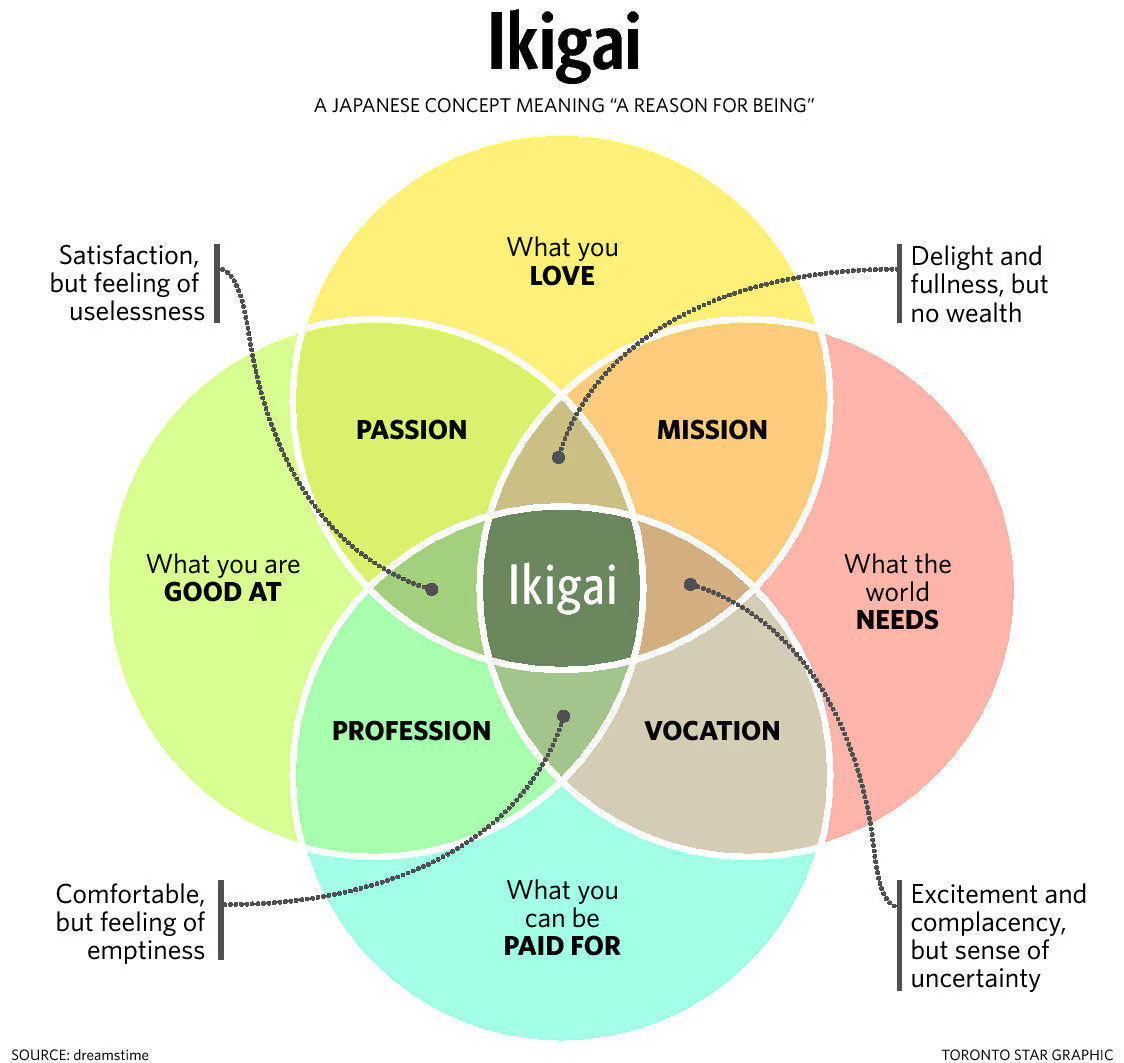
The spirit of the model, holding multiple axes in tension simultaneously rather than optimizing one and hoping the others sort themselves out, is exactly what’s missing from how most developers think about their careers. But the circles themselves need adapting for game development, where the variables are specific and the traps are specific.
So I’m keeping the four-circle structure and rewriting what the circles are.
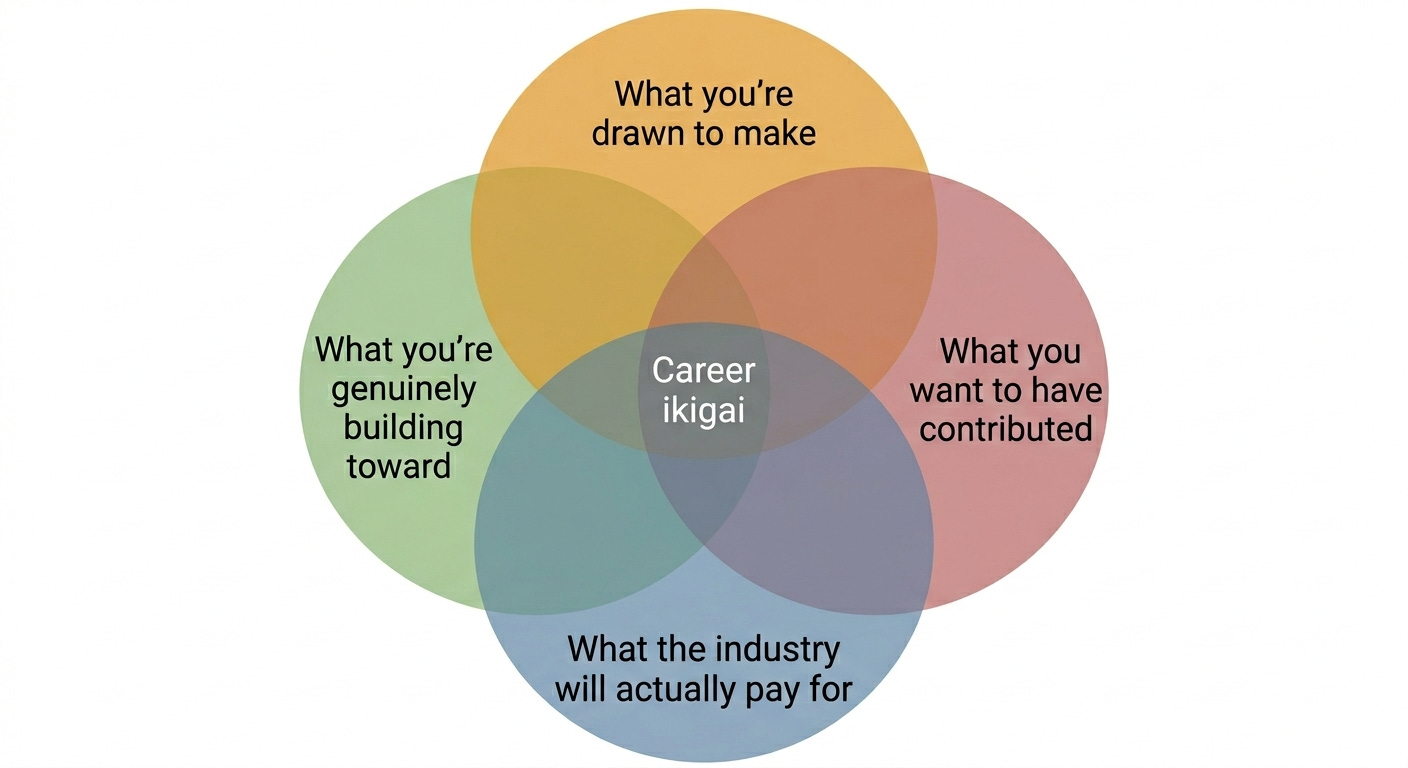
Circle one: what you’re drawn to make
There’s a corner of the internet dedicated entirely to the idea that you should follow your passion, that if you love what you do you’ll never work a day in your life, and so on. The game industry runs the same line, where passion is treated almost as a substitute for other things: a reason to accept low pay, long hours and poor working conditions, because “ you’re lucky to be doing something you love”. I find that framing somewhere between naive and actively harmful.
Cal Newport makes a more useful argument in So Good They Can’t Ignore You (2012). His case is that passion is not the starting point of a good career. It’s frequently the result of one. People who become deeply engaged in their work tend to have developed genuine skill and autonomy in it first. The passion followed the mastery, not the other way around. Which means “follow your passion” is not only vague advice, it may have the causality exactly backwards.
What I’d replace it with is something closer to what Mihály Csíkszentmihályi described in his work on flow: the kind of work you find genuinely absorbing, not just interesting. Not games in general. The particular type of problem that makes time move differently when you’re working on it. The kind of work you’re drawn back to even when it’s hard, that you find yourself thinking about outside of work hours, that doesn’t feel like it requires the same kind of willpower to start as other tasks do.
For some developers that’s the physical feel of an interaction: the weight of a jump, the timing of a parry, the way a camera can be tuned until movement feels alive. For others it’s systems thinking: building economic models, tuning balancing variables until emergent player behavior starts doing interesting things. For others still it’s narrative craft, world-building, the architecture of a space that guides a player without telling them where to go. These are very different types of engagement. Developers who confuse “I love games” with clarity about what they’re drawn to make risk ending up being frustrated that the job doesn’t match what they imagined.
And there’s a sub-dimension here that trips people up. What you’re drawn to make has two components that don’t always point in the same direction: the craft you love practicing and the creative context you want to bring that craft to. The craft is the specific type of work, the discipline, the daily problem-solving. The context is the genre, the tone, the kind of experience you want to help create for players.
A character artist who loves the craft of sculpting but whose real passion is dark, atmospheric horror games is a different person from one who’s equally skilled at sculpting and wants to spend their career on stylized platformers with bright, expressive aesthetics. Their skills look identical on paper, but if you put either of them in the wrong studio, you'll know within a year.
Taking stock of both dimensions, the craft and the context, gives you a clearer picture of what you’re actually chasing than simply “I love games”.
Circle two: what you’re genuinely building toward
Early in a career, this circle is partly unknown. You know what you’re good at relative to your student cohort, relative to other junior developers in your team. What you don’t yet know is what you’re good at relative to the industry, and that gap takes a few years to close.
So this circle is less about current competence and more about direction. A useful question to ask yourself isn’t just “what am I good at right now?” but “what am I developing into being good at, and is that the thing I actually want to be excellent at?” You can be developing the wrong thing for years before you notice.
Imagine this: someone gets hired for a skill they have, turns out to be good at it, gets assigned more of it, and a few years later has become a specialist in something they find… unrewarding. Nobody made a bad decision at any single point. The studio needed what the developer could provide and the developer kept delivering. That type of work just wasn’t what they wanted to spend a career on though. This happens across every discipline, in every kind of studio. It’s surreptitious and ordinary and it’s one of the main ways people end up somewhere they didn’t quite intend to be.
The generalist/specialist question
The generalist versus specialist question lives in this circle, and being intentional about this is important.
Spending your first three years at a small indie studio, wearing multiple hats, working across disciplines because the team is too small for anyone to stay in their lane, will develop you very differently than spending those years at a large AAA studio going deep on one narrow discipline. The first path gives you breadth, contextual awareness and a working understanding of how all the pieces fit together. The second gives you craft depth, real expertise in a specific area of the stack, and some additional credibility from having done one thing really, really well.
Neither path is wrong. But they do lead to different places, and they can open and close different doors.
A relevant model is what Tim Brown at IDEO called the T-shaped person: someone with broad general knowledge across disciplines and deep expertise in one area. The vertical bar is where you can contribute, where you’ve earned legit craft credibility. The horizontal bar is what makes you effective as a collaborator, a communicator across disciplines, someone who can understand the work of people around them even when it isn’t their specialty. Brown argued that people who are “so inquisitive about the world that they’re willing to try to do what you do” are what builds genuinely effective creative teams.
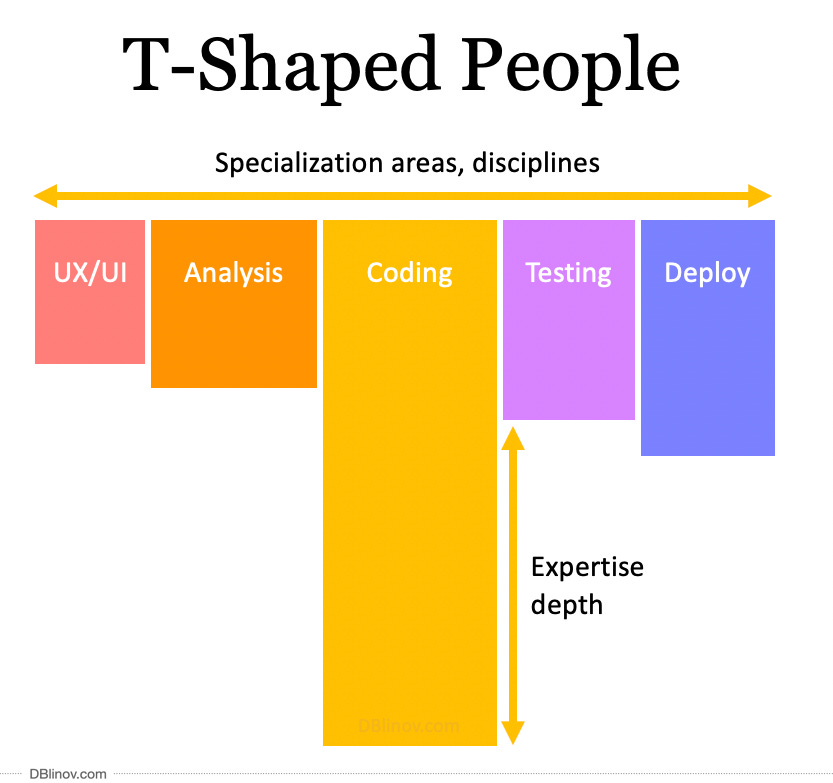
The T-shape is a useful target. But it’s a shape you end up with through deliberate choices, not one that appears on its own. If you spend your first five years going wide without ever committing to depth, you can end up as a generalist by accident rather than by design. That feels different and serves you differently in a hiring market.
Career capital and future value
Newport’s career capital concept is also relevant here. By developing rare and valuable skills, you gain leverage that allows you to shape your career in meaningful ways. Newport also argues that skills which are neither rare nor valuable accumulate into a kind of career debt rather than career capital.
It’s not a bad idea to think about this in concrete terms. Every job you take makes some things easier and some things harder for the next job. Sometimes those are skills. Sometimes they’re relationships, reputation, or the type of work you get associated with. If you spend five years getting excellent at a niche proprietary engine at a studio that then closes, you’ve built some things that transfer and some things that don’t. If you spend your early years getting typecast as “the live service person” or “the mobile person” in a part of the industry you don’t actually want to stay in, the lateral move you want to make in year six is going to cost time and often a step back in seniority that colleagues who started in a different context don’t have to pay.
Thinking about your skills as something that accumulates or depletes, rather than just as the requirements for your current job, is a more useful frame.
Mentorship
Access to experienced developers who can give you honest, specific feedback can accelerate your development in ways that are hard to replicate otherwise. Not because they tell you things you couldn’t theoretically figure out, but because they compress the timeline. A year of watching someone senior navigate a difficult decision, seeing how they think, understanding what they optimize for, is worth considerably more than several years of making the same decisions in isolation. And that kind of access is not equally distributed.
At a large studio, mentorship tends to be structural: you have a lead, you have a manager, there are processes for feedback and development. It can sometimes be less personal but more consistent. At a small indie studio, formal mentorship is rarer, but you may work directly alongside people who are much more senior and experienced than you’d encounter as a junior at a large studio, because the team is flat and everyone is doing everything. So you might find yourself next to the CEO in a pitch meeting with a publisher as a mid-level game designer. That’s a unique experience.
Both environments have valuable things to offer. What matters is whether you’re actively extracting the value available to you in whichever one you’re in, and in many cases that means being proactive about seeking it out rather than waiting for it to be structured around you.
Circle three: what the industry will actually pay for
The implicit assumption early in a career is that good work gets noticed and rewarded, that the market is roughly meritocratic, and that if you’re skilled enough the opportunities will find you. Sometimes that's true. More often than not though, what the market does is reward the right skills in the right context, specifically, and if you're in the wrong one context, then talent alone just isn’t enough.
This circle has at least three components that I want to highlight separately.
Genre and platform economics. Some types of games, and the skills associated with making them, have durable commercial demand. Others are cyclical, trend-dependent, or concentrated in a small number of studios that can absorb only so many specialists. A developer who is deeply skilled in a genre that is contracting, or that is dominated by a handful of large studios that rarely hire externally, is likely to struggle to find work regardless of how good they are. That’s not a statement about the value of the work. It’s just the market reality. Which means it's worth asking, before you go deep on a specialization, whether the market for it is growing, stable or contracting. Not to chase trends, but to know what you're getting into.
Studio health. Early in a career, developers tend to evaluate jobs primarily on the game and the role. The financial health and trajectory of the studio is an afterthought, if it’s a thought at all. This is understandable, because you often don’t have easy access to that information and you don’t yet have the context to read what you’re seeing. But a studio that’s burning through its runway, that has been through multiple rounds of layoffs, that has a public history of employee scandals, or that is dependent on a single publishing deal that hasn’t been confirmed, is a different career environment from one that’s stable and growing. Spending two years at a studio that then closes sets you back in ways that go beyond just finding a new job. You lose the reference, the project disappears from your portfolio or ships in a compromised state, and the skills you built are tied to a game nobody can see. So try to do your homework. Check Glassdoor (or equivalent), look at the studio's release history, ask in the interview how the project is funded. You won't always get straight answers, but the more clarity you can get, the better.
Future value of your skillset. Every skill has a shelf life and a market. The question isn't just whether you're good at something, but whether the specific combination of things you're getting good at is one the industry will pay for in five years, not just today. A developer who spent the 2000s getting excellent at something like ActionScript and Flash game development had genuinely rare skills, until Adobe discontinued Flash Player in 2020 and those skills became somewhat worthless overnight. The underlying programming instincts transferred. The specific expertise didn't. So thinking about your skillset as a portfolio, and asking periodically whether each job is building or depleting it, tends to make career transitions considerably less painful than finding out the hard way.
None of this is an argument against taking the job in front of you. Early in a career, you take what’s available. That’s not a compromise. It’s how most careers actually start. The point is to take it with some awareness of what it’s building toward, and whether the direction is one you can lean into or correct from.
Circle four: what you want to have contributed
This is the circle without a clean equivalent in the original ikigai model. “What the world needs” doesn’t quite fit game development, because it either sounds too abstract or it collapses into circle three.
What I mean by this one is something more personal and with a longer view. At some point in anyone’s career, the question stops being only “what am I good at and can I get paid for it?” and starts to include “what do I actually want to leave behind?”
Partly this is about reputation: what do other developers, studios, collaborators associate with your name? Not in a self-promotional sense, but in the simpler sense of what you’re known for, what kind of work finds you rather than you having to chase it. Reputation is built slowly through an accumulation of choices, and it’s worth having some intention about it, even early, even when you’re not yet sure exactly what you want it to be.
But there’s something smaller and harder to quantify underneath that. Games are experiences that matter to people. Players spend hundreds of hours in worlds that developers built. Some of those worlds leave a mark: many games helped people go through a hard period, others made them feel understood, and others people still think about a decade later. That’s not something you can entirely control, but it’s something you can at least orient toward.
Developers who never ask themselves what they want to have contributed risk ending up in a particular place in the middle of their careers, which is: technically excellent, reasonably well-compensated, and genuinely unsure about why any of it matters. That’s not exactly a crisis, but it means one of the circles might have been neglected for a long time.
This is also the circle that is most resistant to external disruption. Markets shift, technologies ride the hype and die out, studios close, genres that seemed permanent turn out to be cycles. The question of what you want to have contributed doesn’t really care about any of that. This is yours.
The spaces between the circles
The spaces between the circles are where most developers actually live, at least for stretches of their career. Full overlap across all four is rare, and probably temporary even when you have it. What's more useful than chasing the center is understanding what the partial overlaps actually feel like, because they're specific situations with well-defined costs, and knowing which one you're in is the first step to doing something about it.
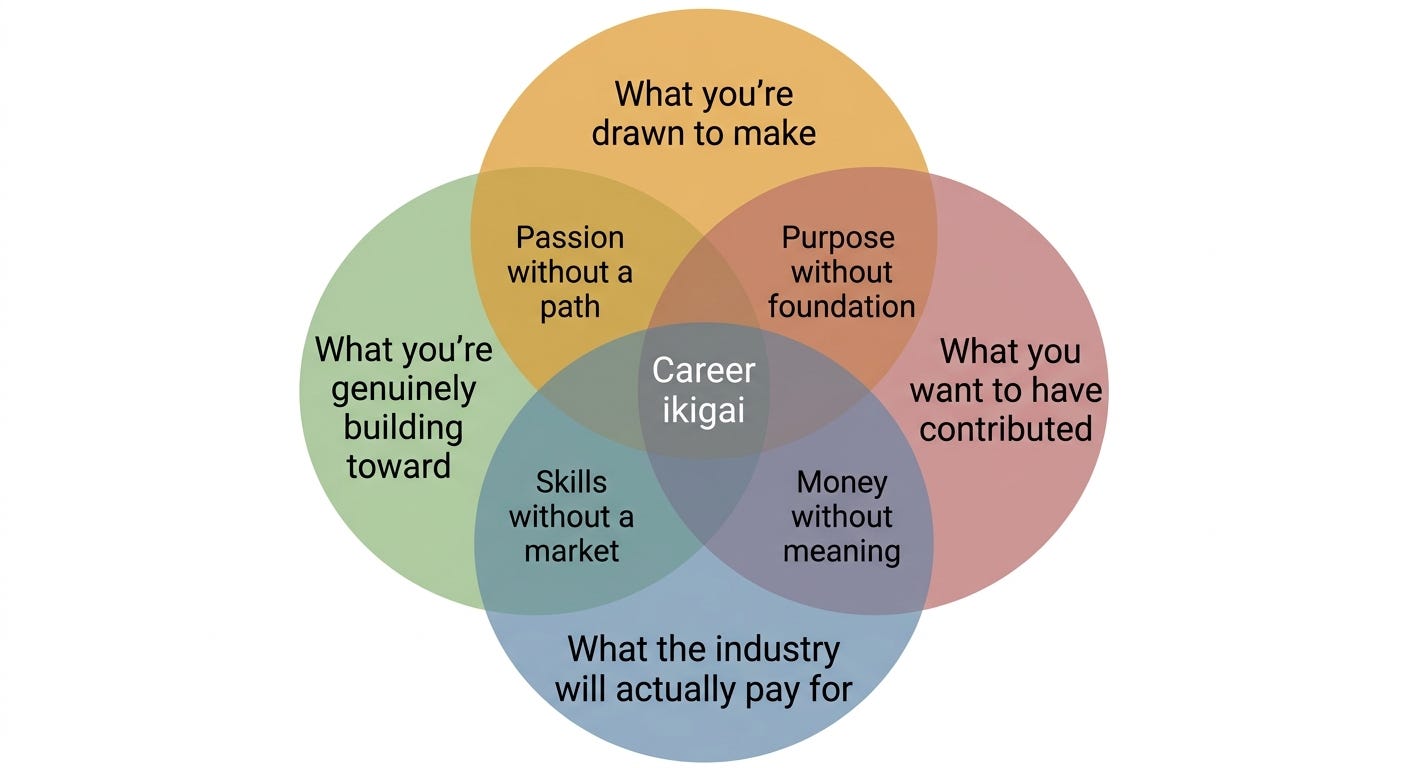
Passion without a path is where you’re engaged by your craft and actively developing it, but you haven’t connected it to a sustainable market yet. The portfolio full of carefully made, almost-zero-revenue games on itch.io could be an example of this scenario. There’s nothing wrong with this per se. For some developers it’s a deliberate choice: they have income from elsewhere, or they’re early enough in their career that market viability is secondary while they build their craft. For others, it’s a situation they ended up in without quite planning to, and the financial reality catches up. Understanding that is important.
Skills without a market is more common than people realize, and my sense it that it tends to go unnoticed precisely because the skills are there and improving. Everything feels like it's going in the right direction. Think of developers who built expertise in blockchain integration and smart contract development during the play-to-earn wave of 2021 and 2022 were working on genuinely in-demand skills, at studios that were hiring aggressively and paying well. When that whole Web2 market collapsed, most of those studios shut down or pivoted entirely, and the specific expertise didn't travel well back into mainstream game development. Getting better doesn't guarantee the market will still be there when you arrive.
Money without meaning tends to be fine in year two and genuinely difficult by year seven. Technically capable, reasonably well-paid, and starting to increasingly dread Monday mornings. Observationally, I’d argue that this is far from unusual. The financial stability was never the wrong objective. What’s missing is a connection between the daily work and either of the other circles, and the problem only gets worse the longer it’s ignored.
Purpose without foundation is another common early-career situation. You have a clear sense of what you want to contribute, a strong orientation toward the creative or technical context you want to be part of, but you haven’t built the skills or found the market position to get there yet. In some sense this is just being early in a career: there’s a clear gap but it’s closeable. What might keep it from closing is when someone isn’t deliberate enough about doing exactly that, just waiting for the right opportunity rather than building toward it.
Tradeoffs aplenty
The classic ikigai diagram puts the prize in the center. But the zones outside the center aren’t failures at all. They’re just tradeoffs, and some of them are legitimate, even good, depending on what you actually need from your career.
A developer who is deeply engaged by their craft and building great skills in an area they care about, but who hasn’t found a financially sustainable path yet, isn’t in a crisis. They may be in an early-stage career that may need course correction, or they may have made a deliberate choice: economic stability matters less to them than creative alignment, and they’ve structured their life accordingly. That’s all perfectly fine.
A developer who is well-paid, in a stable part of the industry, building skills that the market values, but who isn’t particularly passionate about the work, isn’t doing anything wrong either. Maybe meaning comes from outside work, from family or creative projects or community. Maybe they went through a period of financial hardship that makes stability feel valuable in a way that’s hard to explain to someone who hasn’t. Their career is not broken because one circle is lighter than the others.
Self-determination theory, developed by Ryan and Deci, identifies three basic psychological needs behind motivated, fulfilling work: autonomy, competence and relatedness. A career can satisfy some of those more fully than others and still be a good one. This framework is a tool for reflection. It’s useful for making tradeoffs visible, so they can be chosen rather than stumbled into.
The early years matter more than they seem
The choices you make in the first three to five years of a game development career shape what choices you have available later in a more dramatic way than they feel in the moment. Early choices determine what you’re good at. What you’re good at determines what you get hired to do. What you get hired to do determines what you’re good at next. So the career you end up with is the accumulated result of dozens of decisions that each felt small at the time.
This is especially true of the generalist/specialist question, of which genre and platform you build your skills in, and of which studios you associate your early work with. Moving between contexts later, from mobile to PC, from free-to-play to premium, from live service to single-player, is definitely possible but it’s not free. It costs time, often money in the form of a step back in seniority or compensation, and sometimes a fair amount of self-awareness and patience.
None of which means the first job has to be perfect. It rarely is, actually. The question isn’t whether you landed in an ideal situation straight out of school, but whether you have any sense of where you’re trying to go, and whether the decisions you’re making are building toward that or away from it.
The difference between “I took this job because it was available, and it’s not perfectly aligned with what I want, but I know what I want and I’m going to be intentional about the next move” and “I took this job and I haven’t really thought about the next move yet” can prove remarkably important a few years later.
Putting it to work
If you’re just starting out
Before you’ve accumulated much career history, the most useful thing this framework gives you is a set of questions to hold as you evaluate early opportunities.
When you’re looking at your first or second job, ask yourself: does this studio work in the creative territory I’m drawn to? Even if the specific role isn’t my ideal entry point, will I be surrounded by the kind of work I want to get better at? Is this a studio with enough stability that I’ll have a year or two to actually develop, or is there a real chance this disappears before I’ve built anything? And is there someone here I can learn from, or will I be developing in relative isolation?
None of these questions have clean answers when you’re just starting, and you rarely have the information you’d need to answer them fully. But asking them, even imperfectly, is a different posture than taking the first offer and figuring it out later.
The annual check-in
Once a year, maybe when a contract is ending, or a job is starting to feel wrong, or you’re at a crossroads, take the time to go through the four circles candidly. Not once to fill them in and be done, but as a recurring review.
Below is a simple rubric to structure that review. Score yourself 1 to 5 on each question. A 1 means this is a genuine gap or problem right now. A 5 means you’re in a genuinely strong position on this dimension.
Circle one: what you’re drawn to make
Do I know specifically what kind of work I find engaging, as distinct from “games in general”? (1 = not really / 5 = very clearly)
Am I currently doing work that connects to that, or building toward it? (1 = not at all / 5 = directly)
Does my current role connect to the creative context I want to be part of? (1 = not at all / 5 = yes, this is exactly the territory)
Circle two: what you’re genuinely building toward
Do I have a clear sense of the skills I’m trying to develop and why? (1 = I’m just doing my job / 5 = I have a specific development direction)
Is my current role actually building toward that, or am I getting good at something else? (1 = something else / 5 = directly)
Am I getting the breadth and depth I need for where I want to be in five years? (1 = neither / 5 = both, deliberately)
Do I have access to meaningful mentorship or senior guidance? (1 = none / 5 = strong and active)
Circle three: what the industry will actually pay for
Is the genre, platform and studio type I’m in economically healthy? (1 = contracting / 5 = growing)
Is the studio I’m at financially stable? (1 = significant uncertainty / 5 = stable and growing)
Are the skills I’m developing ones the industry will value in five years, not just today? (1 = specialized and narrow / 5 = durable and transferable)
Circle four: what you want to have contributed
Do I have a sense of what I want to be known for, even a rough one? (1 = not really / 5 = quite clearly)
Does my current work connect to that? (1 = not at all / 5 = directly)
Am I working on the kind of experiences I’d be glad to have helped create? (1 = not particularly / 5 = yes)
Any score of 1 or 2 in an area you care about merits taking a moment and thinking through. Not as a crisis, but as a genuine question: is this a deliberate tradeoff I’ve made, or is it a gap I’ve let develop without choosing it?
A note for mentors, managers and leads
This framework isn’t only for developers figuring out their own careers. It’s a useful lens for anyone who is developing other people.
If you’re a lead, a manager, or in any position where you have influence over someone’s development, running through these questions with your direct reports in a 1:1 can open conversations that wouldn’t happen otherwise. Where are they drawn creatively? What skills are they trying to build, and are the assignments you’re giving them actually building those skills or just meeting the team’s short-term needs? Do they have a sense of what they want their career to stand for?
The developers who got deliberate early usually had someone in their corner who helped them get that way. It’s one of the most useful things a senior person can do for someone junior: help them see the whole picture before the early decisions have already been made.
If I had somehow known you 25 years ago and followed your advice, I feel like I might have had a shot at a career in games development. Valuable advice for anyone, as always.