

The next game decision
Five variables to assess what game to make next and why

Every studio that ships its game, sooner or later has to figure out what comes next. It can be a sequel, an expansion, a new IP, pivot to a new genre altogether, or a make a deliberate pause to recover. It’s a fairly important call that a studio has to make, and plenty of them make it without a great deal of strategic thought.
The chat tends to happens late-ish, when the team is pretty darn worn out, and it gets pulled around by whoever feels strongest that week or by whatever the revenue dictates at the time. So, important facts go unchecked, good options get dropped for weak reasons, and questionable ones get extra attention because they feel exciting in the moment.
There’s a better way to approach this. Before the creative question even comes up, five practical variables have somewhat narrowed your options already. They’re what your contract allows, what your revenue enables you to do, how much of your existing work carries over to the next game, what your team has left in the tank and only then what it is that you’re all creatively driven to do.
In this article I walk you through all five, so that whatever you choose does right by the studio, the team and the people who’ll play what comes next.
1. Contractual obligations
If you self-published and kept all rights, go ahead and skip this section. Everyone else, I suggest you dig out the agreement before the first brainstorm, because your publisher gave your next game a great deal of thought long before you did. They kind of have to.
There’s a study of 3,576 UK game companies showing that publishers go under at far higher rates than developers, and that they cope by funding follow-ups to titles that already worked instead of new bets.
So when your game performs, a sequel becomes a publisher’s safest possible investment, and the agreement you signed probably already reflects that.
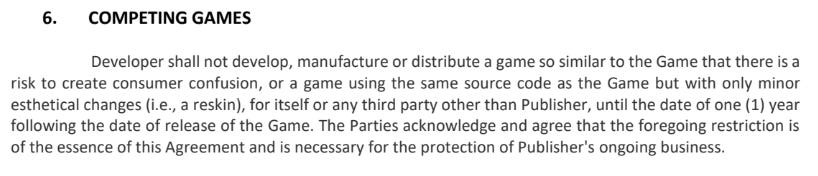
Some clauses constrain what you’re allowed to develop next. The non-compete is the worst one. Raw Fury’s published example contract restricts releasing “a similar type of project” for 12 months after launch, and depending on how broadly yours is drafted, that can rule out a fast follow-up in your own genre. The license scope is trickier. If it’s written around your characters and universe rather than the game itself, it can block a sequel outright , since any sequel lives in the licensed universe by definition.
Other clauses don’t dictate the game so much as who you’ll be making it with. These are the option rights on future work, and Brandon Huffman, a games attorney and general counsel to the IGDA, describes the three common forms.
A right of first look means showing them the next game before anyone else and giving them a window to make an offer, which you may refuse, so as obligations go it’s a light one.
A right of first negotiation is heavier: no talking to other publishers until you’ve tried in good faith to close a deal with this one. Some come with a no-shop clause on top, so you can’t even use their offer as leverage elsewhere.
And a right of last refusal lets them match any deal you bring back from the market, which sours the other publisher’s enthusiasm for ever negotiating with you again. Huffman recommends refusing all of these at signing, and I’d echo that. If one is already in your agreement, then at minimum negotiate a hard deadline by which the publisher must commit to the next game or release you, so the studio isn’t stuck waiting while they make up their mind.
All of this is boilerplate, mind you, signed back when getting funded was understandably the only thing on anyone’s mind, and it tends to resurface around this point in time. If game two involves pitching publishers again, the publisher relationship guide can help with the negotiation. In any case, one afternoon rereading the PDF with the contract and taking notes is pretty much a must.
2. Funding
The second variable is your bank account, or more precisely the durable monthly revenue rather than the launch spike on the partner dashboard. I’m talking about the post-refund, post-platform-cut, post-tax number (more on the financial primer). Once you have that, sorting the options gets a lot easier.
Take DLC for instance, which plenty of teams treat as the seemingly cost-effective continuation. But is it? Chris Zukowski scraped all 14,399 Steam releases from 2024 and found that DLC tracks the base game’s revenue very tightly. Around 68% of games that grossed over $1M shipped at least one DLC, versus 21% for games in the $10k-to-$149k range and 5.7% below that.
His advice is consistent with all that: headed past $150k? Prepare DLC. Around $10k? A small supporter pack is fine, say a week or two of work. Below that, he recommends skipping the expansion business altogether and making your next game. An expansion only sells to people who already own the game, so that revenue ceiling is your existing audience multiplied by their attach rate. On a small base, that’s months of effort to sell something to very few people.
A new game is of course a much bigger check. Say, two-plus years of production funding, give or take. If the first game banked that kind of money, then congratulations, you’ve earned the rare privilege of self-funding. This is how Supergiant built Transistor entirely off Bastion’s earnings without taking a cent from publishers. If your game didn’t, then you’re bound to pitch again, except this time with a shipped title to your name, which does count for something.
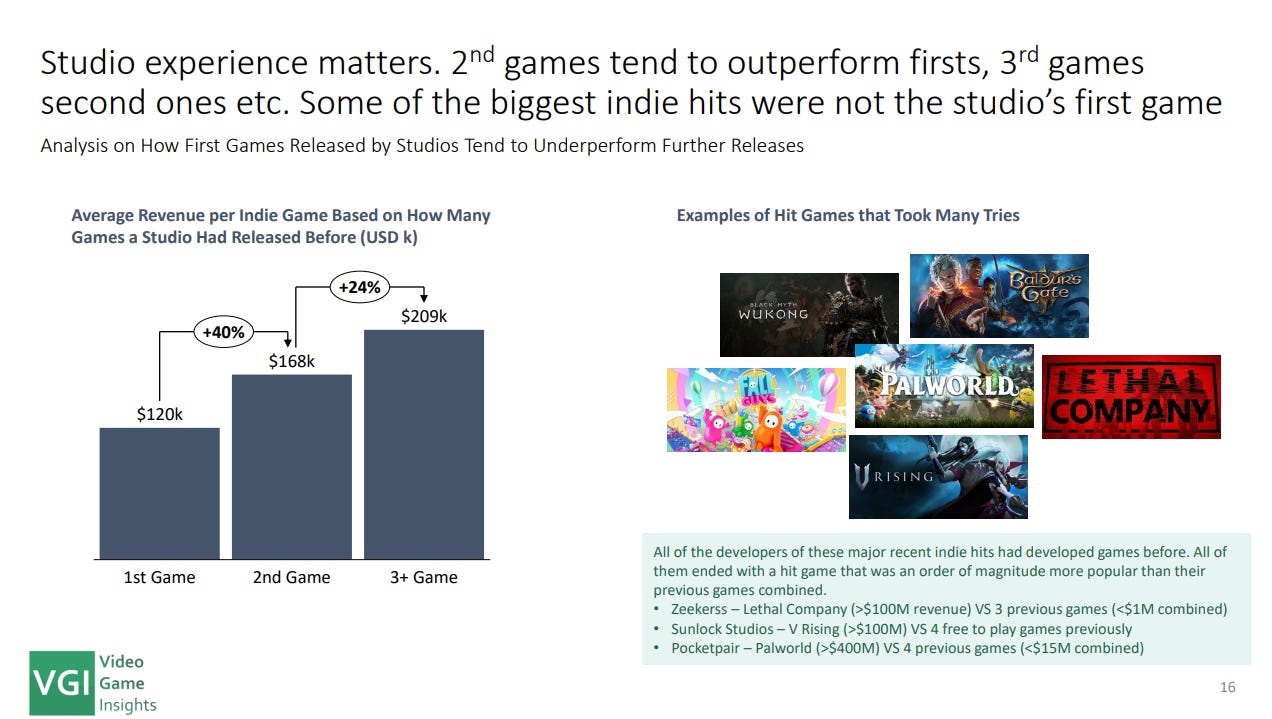
On Steam, second games average 40% more revenue than debuts, $168k against $120k per Video Game Insights’ estimates. That said, you have to take that number with a pinch of salt, because it’s an average over a hit-skewed distribution, and the sample only includes studios that managed to ship a second game at all, which the same report suggests is roughly one studio in three. Experience pays, yes, provided you survive long enough to collect.
Then there’s taking a break, which no P&L will ever recommend. Doing nothing still costs full burn, which is largely salaries times months, and produces nothing immediately visible. Some studios can afford one. The ones that can have usually earned it on game one’s revenue, and if yours can’t, the pause shrinks to the few weeks of leave I’ll get to below, with the next project starting rapidly out of necessity.
And if keeping game one alive as a live game is on the menu, please understand that you’re not weighing a “just a project”, you’re weighing a permanent operation with economics all of its own. I wrote a whole primer on what that life costs, so I won’t repeat it here, other than to say: read it before live ops makes it onto the whiteboard.
3. What may transfer to the next game
Shipping one game leaves you with a fair bit more than just the game. By the end you own a pipeline that demonstrably works, tooling shaped to the genre, a team that knows how to work together, a team with institutional knowledge of this type of game and this type of genre, an audience, possibly an IP with some recognition attached to it, relevant partnerships, etc.
Every candidate for game two keeps part of that transferable inventory of capabilities and abandons the rest. That’s a major consideration.
Tech is the first and most obvious evaluation. When Klei followed up the Shank 1 and 2 brawlers with a stealth game, they were taking a total design risk but close to zero technology risk. Their Mark of the Ninja postmortem credits the reused stack: “Had we also started our technology from scratch, we could easily have spent over a year in pre-production.” They still built new tools for the stealth iteration, of course.
As a rough rule, an adjacent genre reuses most of the stack, a distant genre maybe keeps the engine and not much else, and swapping engines means starting from very nearly nothing.
The audience is another element that might conceivably come with you. Mechanically speaking, wishlists die with the game they were collected for, they do not transfer. That said, what does transfer on Steam is followers of your developer and franchise pages, who get an email when the next game goes live. The rest is cross-promotion run from inside game one, which is admittedly an unglamorous channel, but one that performs really well. Butterscotch Shenanigans found that linking to the sequel from the original’s store page and from inside the game outperformed everything else they tried, combined. So if you stay close to what your audience already bought, the carryover can be substantial. Strange Antiquities, the follow-up to Strange Horticulture, opened with 180k wishlists where the original had opened with about 20k, and an estimated 68% of its buyers owned the first game.
If you wander far, the carryover evaporates, as developer Introversion learned. Prison Architect sold over two million copies, and the studio’s next release, a first-person exploration experiment, managed around 6,000 copies in its first two months. Chris Delay admitted afterward: “I wrongly assumed that would just give us a minimum number of people looking at our game.” The audience, in this case, belonged to the game, not to the studio that made it.
There’s also academic backing for that. One study of 2,918 console releases found that new-IP games sell substantially less on average than sequels and licensed titles. The penalty gets even worse late in a platform’s life, once risk-averse late adopters make up most of the buying public.
Let me give you a couple of examples from two studios that went in diametrically opposed directions. Image & Form had a hit with SteamWorld Dig and refused the obvious follow-up. As Brjann Sigurgeirsson put it at the time: “If we make Dig 2, we’re going to be this mining platform game developer. Can’t we do something else?” The one constraint he kept was the universe, so every new genre still launched into the previous game’s audience. Ten years on, no genre is off the table for SteamWorld and a sequel still counts as an option. Zachtronics, on the other hand, went very much the other way and spent twelve profitable years in a single programming-puzzle niche, with an audience that was cheap to reach and glad to pay. Mind you, Barth addressed the cost when he closed the studio in 2022: “while we got very good at making ‘Zachtronics games’ over the last twelve years, it was hard for us to make anything else,” he wrote.
4. What the team has left in the tank
The team that shipped game one may not quite be the team that will start game two, even if every single person stays. Shipping changes people. There’s a great GDC talk on this, Danny Day’s 2016 survey of indie teams after release, built on 18 recorded interviews plus a few dozen questionnaire responses, and its findings are sobering. Morale trends downward as projects drag on, and individuals report feeling worse than their teams let on. Post-launch depression, in his words, definitely exists.
There’s one specific finding that I want to draw attention to: every studio he spoke to gave at least two weeks of paid leave after shipping, with most giving more. Clearly that doesn’t seem to be enough. His advice was to wait until people are going crazy from not building anything, because the appetite does come back on its own. If you drag people back early, you might get a team that says yes to the sequel in week two, but that resents it throughout production.
Observationally, I’d say that the studios with the better track records seem to treat rest as a scheduled step, not as a reward. Supergiant said their plan after Hades 2 reached 1.0 was support the launch, then take a break and only then figure out what comes next. A Hades 3, Amir Rao went out of his way to add, is “not preordained” even with two hits in the franchise. Innersloth went a step further and built the recovery into their portfolio. After years of live-service grind on Among Us, they spun up a smaller “pit stop game” on purpose because, as Forest Willard put it, “It allows for a cooling-off period for employees.”
And then of course there’s the creative and professional appetite, which I think is best addressed person by person rather than at the all-hands. Who really, truly, genuinely wants another tour on this game, or even in this genre? You’ll hear different answers from the people who joined for the game itself than from the ones who joined for the craft or the ones who simply joined because it’s a job, which is perfectly fine. And a sequel staffed by people who privately wanted out is unsurprisingly more likely to produce a flat second game and a retention problem at the same time. I’ll admit I have no study to back that one, just a fair amount of body language seen over the years.
5. The studio’s creative itch
After all that homework, you’re finally at the creative choice, the one the team wanted to have on day one. The good news is that the studios who’ve made this call repeatedly have left somewhat of a method lying around for the rest of us.
Ryan Clark has shipped profitable games for two decades, Crypt of the NecroDancer among them, and his approach to picking the next one is a comps test. Take the 10 or 20 games closest to your candidate and explain, game by game, why each one succeeded or didn’t. He also warns about the default instinct of taking hit game X and making “X but better, or game X but in space,” which in his telling produces good games and rarely noteworthy ones. As he puts it: “If you are not confident in being able to explain why the hits hit and why the others do not, you shouldn’t be confident about your game’s chances either.” I created a game analysis rubric for this, so consider checking it out.
Also prototype before you commit, rather than debating in the abstract. Supergiant’s third game didn't even have a pitch document. It grew out of a theme, what happens when you face defeat, that the team prototyped until it became a playable answer, with external playtesting closing arguments in a much more effective way than meetings.
Subset Games took the same idea to an extreme and spent years after Into the Breach building prototypes without promising any of them to anyone, openly saying they had no idea which would become a game, if any. Granted, that kind of patience is a lot easier with FTL money in the bank. The gist of the idea holds though: a hundred hours of prototyping will answer questions that a hundred hours of debate won’t. It’s as simple as that.
A couple of warnings before you run off to prototype. Day’s survey had one that stood out to me: don’t put the studio’s survival on the prototypes’ shoulders, because prototyping under a “we need a hit by March” deadline is a surefire way to stress the hell out of the team. I also have a writeup about how to cultivate a culture of experimentation that might be relevant if you’re at that stage.
And last: you should be cognizant that you are allowed to decline what on paper seems like the obvious option. Larian got on a GDC stage in 2024 and walked away from the most anticipated sequel in the industry. No Baldur’s Gate 3 expansions and no Baldur’s Gate 4, Swen Vincke told the audience, the studio was simply going to move on. Re-Logic had spent three years on Terraria: Otherworld when they pulled the plug. Their statement said the build was still far from the vision and far behind schedule, and that quality was “not something we are willing to compromise on to make a quick buck.” And back to updating Terraria they went.
I’d be remiss not to point out that both studios said no from a position of overwhelming strength, with all four facts in their favor, and both kept supporting the game that built that strength. So please know that you too are allowed to refuse the default option, whichever that may be, as long as the contract, the bank and the team agree.
The timing of the decision
Everything above has assumed you decide after the game is out. That’s the simple case, and for a small team it’s often the most common one. But it isn’t the only option. There are three reasonable moments in which you can stop and figure out what the studio’s next game will be.
The earliest window is during closing, before the game has even shipped. The closing phase very often doesn’t need the whole team (provided it’s not a game made by only 2-5 people, in which case they’re much more likely to all be needed), so as the game moves into stabilization and certification, some people finish it while the rest find themselves free. Those freed-up people need a deliberate destination, as I argue in the closing guide, and concept work on the next game is one of the better things to do during that time. There’s a money argument for it too. If you’re 15 people on a platformer you already suspect won’t bankroll the next project, every idle month is burn rate you just can’t justify. So, plenty of studios peel off a couple of people late in development, even part-time, to start spinning ideas, or run a two-day hackathon that doubles as a way to re-energize a tired team.
The second window is the few weeks right after launch. The team is wrung out, the sales numbers are still mostly launch-window noise, and you’re being asked to make a big call on both at once. It’s not ideal, and many studios decide here regardless, because waiting is a luxury their runway might just not afford. If that’s you, lean on the contract and the capability facts, which don’t change with the team’s mood, and treat the early revenue assessment as provisional.
The third window is a little later, six to twelve weeks out. By then the revenue curve is a lot more stable, and credible, and the team has had some time off, so the appetite question is hopefully no longer a factor. It’s probably the most transparent and honest analysis you can get, but it’s also the most expensive, because you buy that clarity with weeks or months of thin to no creative output, which is a lot to shoulder if the revenue numbers are not strong.
None of the three is right in the abstract. They’re all very much contextual. A funded team coming off a hit can afford to rest and choose late. A lean team on a modest earner often can’t, and starting during closing is less a best practice than a survival move. Pick the window your money and your headcount actually allow.
Wrapping up
None of this tells you directly what to pick next, but it hopefully keeps the choice from “happening to you”: by a contract clause you forgot, a revenue number you hoped was bigger, an audience that isn’t quite there, or a team that checked out six months ago. Being deliberate requires some discipline but is not that hard. An afternoon with the contract and a few honest conversations can go a long way. Getting it wrong isn’t always expensive but it can be.
That’s the whole case for evaluating these variables before the exciting one: what do we feel like doing? Being concerted simply maximizes the chances for the studio to succeed, the team to thrive, the next game to start with its best foot forward, and gamers to have the best, most fun game possible.
What did your studio choose after its first game, and how did it go? Reply or comment and tell me about it.
If this was useful, you might also like:


I'm Sebastian. Twenty years across AAA studios (Riot, Crytek, EA), indie and founding roles. I write at Game Studio Unlocked because I want to help the next generation of indie game studios do great. I also work directly with a few studios at a time as a fractional COO and executive producer. More at gamestudiounlocked.com or on LinkedIn.
The point about making sure you bake a hard deadline into the options a publisher may hold over you is very astute. People tend to forget how long contractual negotiations and agreements can actually take, and it's not fun burning through all your runway while conversations happen at a snail's pace! This is also critical during *initial* negotiations with publishers, and lead time on agreements is something I think often gets forgotten about. It's expensive simply to stay in the game!
The gold master moment used to be a hard stop. You shipped the disc, you were done, and however bruised the team was, there was at least a clean line where the work ended and the recovery could begin. That's largely gone now. Day one patches, DLC, live service obligations, platform compliance updates mean the people who know your engine deepest, who can squeeze the most out of your studio's hard-won kit, are often the ones who never actually get to stop.
Which makes your point about post-launch depression land even harder. It's not just that rest needs to be scheduled. It's that for a lot of veterans, the signals are harder to read because they've learned to push through. That's where active listening and genuine emotional intelligence become part of the producer's job. Not the all-hands "how's everyone doing" but the one-on-ones, the reading of what's not being said. The person quietly putting in the hours who has clearly left the building mentally. You don't find that in a retrospective.
A sequel staffed by people who wanted out will show. I've seen it. The trick is catching it before the greenlight, not after the first milestone review.